
- On: 29th Apr 2026
- Category: Movie Reviews
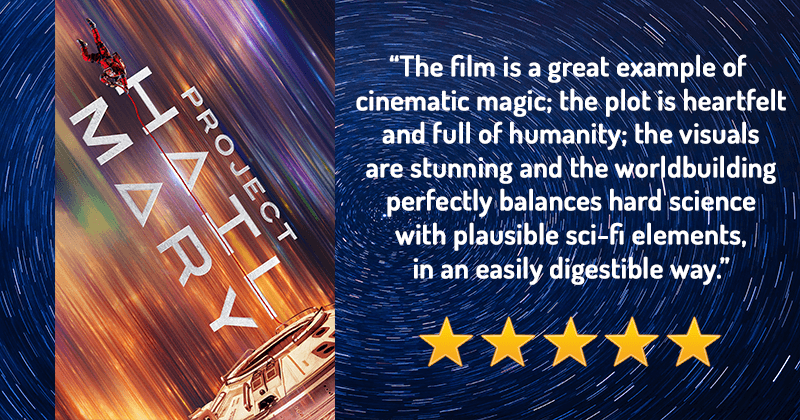
Project Hail Mary, first released in 2026.
I haven’t yet read any of Andy Weir’s books, but his works are on my reading radar, and I have enjoyed the film adaptations of both The Martian and, more recently, Project Hail Mary.
Overall, the film is a great example of cinematic magic; the plot is heartfelt, full of humanity, and emotionally captivating; the visuals are stunning and largely practical to boot; and the worldbuilding perfectly balances hard science with plausible sci-fi elements, all in an easily digestible way.
There were several aspects that I really loved, but be warned, spoilers lie ahead!
One of the most enduring questions for humanity is: are we alone? Stories that deal with this question, one way or the other, are always interesting to me, and Project Hail Mary is no different. For a start, the ‘enemy’ of the film, the astrophage, is a single-celled organism that feeds directly off the output of stars, absorbing immense amounts of energy converted directly into mass, which is such a cool concept. They’re able to reconvert this mass back into energy, emitting infrared light as propulsion, allowing them to move between stars and carbon dioxide-rich planets to reproduce, but also to move between stars. Outside their system of origin, they multiply unchallenged, becoming so populous that they physically block energy leaving the host star, dimming luminosity by approximately 10%. For inhabited worlds like Earth, this is catastrophic.
After the film’s protagonist, Ryland Grace, arrives in the Tau Ceti, the only star not dimming, he discovers he’s not alone. An alien vessel carrying a sole survivor has also arrived in the system, seeking answers about the astrophage. Dubbed ‘Rocky’ by Grace, the alien is a five-legged, rock-like creature from a planet in the 40 Eridani A system. Some of the film’s best moments centre on the first contact between Human and Eridian, as they slowly establish communication, build understanding of their shared mission, and form a friendship as they cooperate to solve the astrophage problem.
During their quest to understand the astrophage, Rocky and Grace discover that when they travel to Tau Ceti’s carbon-rich planet, the atmosphere is teeming with microbial life, some of which prey on the astrophage. This explains why Tau Ceti is the only star not dimming and is the third instance of alien life in the film. Called Taumoeba by our protagonists, the organism is harvested from the planet’s atmosphere and bred, cultivating the numbers needed to send to Earth and Eridani, saving both worlds from imminent death.
The film has plenty of other cool elements, but I highly recommend you discover those for yourself! It’s projects like Hail Mary that reinforce why I love science fiction, and why I strive to create captivating sci-fi worlds and tales of my own. To sum up the film in the way that feels most appropriate, as Rocky would say, “Amaze! Amaze! Amaze!”
Share to:
)
Recent Posts
Movie Review: Project Hail Mary
- Apr 29th 2026
Review: Beyond the Reach of Earth by Ken Macleod
- Jan 24th 2026

Review: The Sagan Diary by John Scalzi
- Sep 15th 2025